


Ecuadorians March Against Job Insecurity and Militarization of Protests
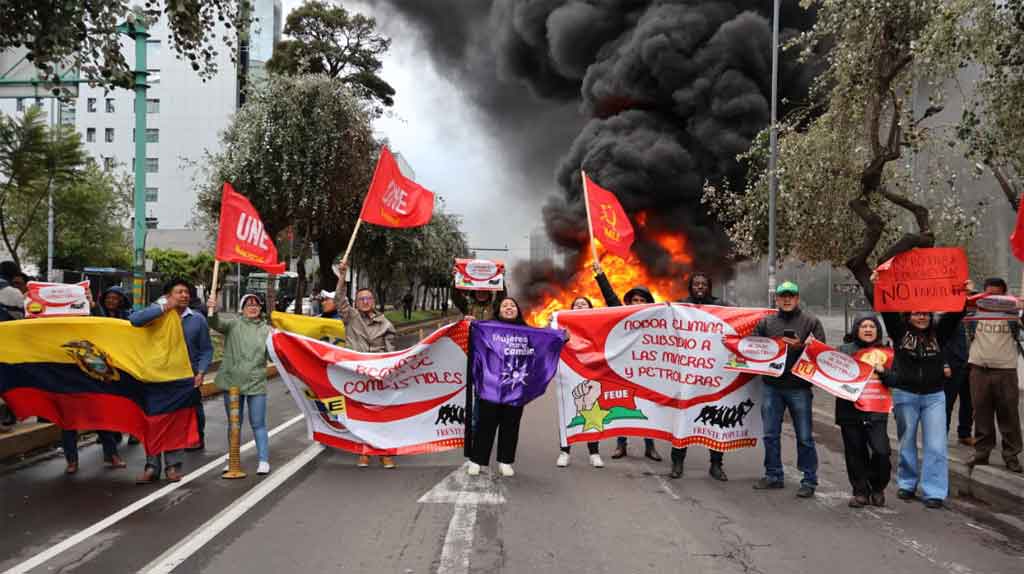
Thousands of Ecuadorians mobilized on May 1st in various cities to reject government policies of labor flexibility, denounce the high rate of underemployment, and question the military deployment during the protests.
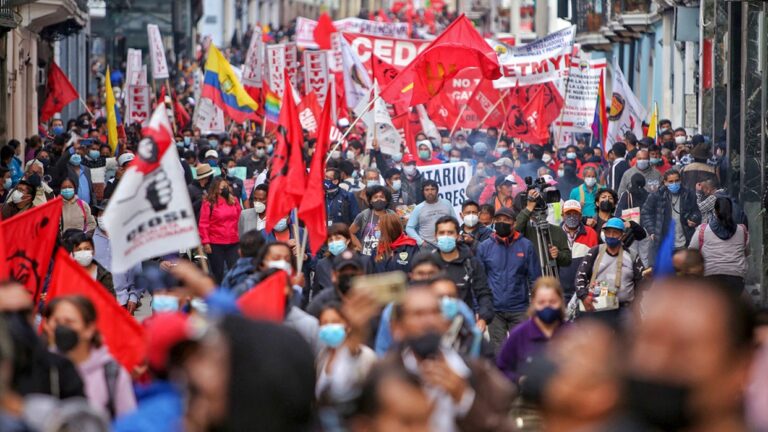
Ecuadorian workers march this May 1st. Photo: Prensa Latina
May 1, 2026 Hour: 2:02 pm
🔗 Comparte este artículo
Thousands of Ecuadorian workers marched this May 1st, International Workers’ Day, in Quito and other cities across the country to reject job insecurity and President Daniel Noboa’s policies, which arer affecting their rights and living conditions.
The march in the capital proceeded towards Santo Domingo Square under a significant military and police presence at various points along the route.
RELATED:
Ecuador to Impose Curfew as Homicides Hit Record High
The protesters chanted slogans such as “Out with Noboa, out!” while union leaders questioned the deployment of security forces.
Nelson Erazo, leader of the Popular Front, stated that the presence of armored vehicles near the start of the march was a message of intimidation and demanded urgent measures to stop the rising cost of living, as Ecuadorians can no longer endure this situation.
Erazo reported that the day marks the beginning of actions to collect signatures with the goal of recalling President Daniel Noboa, whom they hold responsible for the deterioration of the country’s conditions.
For his part, Geovanni Atarihuana, national president of Unidad Popular, asserted that citizens are taking to the streets in a context of widespread discontent and also questioned the participation of the military in the protests.
The text reads, “The annual report from Reporters Without Borders is unequivocal: 2026 marks the worst level of press freedom in 25 years. Ecuador is one of the most worrying cases. For the first time in the history of the ranking, more than half of the world’s countries are in a “difficult” or “very serious” situation for practicing journalism.“
Similarly, Andrés Quishpe, head of the National Union of Educators (UNE), denounced the dismissal of 100 teachers this week and clarified that May does not end with these actions, but rather represents the beginning of a broader agenda of struggle.
He also reported on the arrival of an international trade union mission linked to the International Labour Organization (ILO) to observe the labor situation in Ecuador and announced a new national day of mobilization planned for May 28 with demands related to health, education, and employment.
José Villavicencio, president of the General Union of Workers of Ecuador (UGTE) and vice president of the United Workers’ Front (FUT), stated that 70 percent of Ecuadorians are underemployed, meaning they work in inadequate conditions, without guarantees, or in the informal sector. Villavicencio indicated that the protests are taking place under slogans of security, democracy, social justice, and decent work.
Among the measures questioned by the protesters are labor flexibility, such as schemes that allow workdays of up to 10 hours, and layoffs in the public sector following reforms that facilitate dismissals.
Social organizations also warned of restrictions on union activity and the weakening of labor control mechanisms.
The text reads, “The Street Dogs collective took to the streets this May First: they reject Noboa’s submission to the interests of the United States and raise their voices against the genocide that the gringos and Israelis are perpetrating against the Palestinian people.”
Edwin Bedoya, president of the FUT, denounced that the Executive Branch prevented them from setting up the stage for the closing event of the march, despite having all the necessary permits, and criticized the militarization of the protests.
“Deploying tanks, soldiers, and police speaks volumes about how this government is heading toward a dictatorship of the oligarchy. (…) We cannot allow these kinds of authoritarian and dictatorial governments to usurp the sovereignty of the Ecuadorian people,” Bedoya emphasized.
Labor unions in the cities of Guayaquil, Cuenca, Latacunga, Ambato, and Loja also marched on May 1st, joining the national rejection of labor policies.
Author: HGV/JF
Source: @ElenaDeQuito